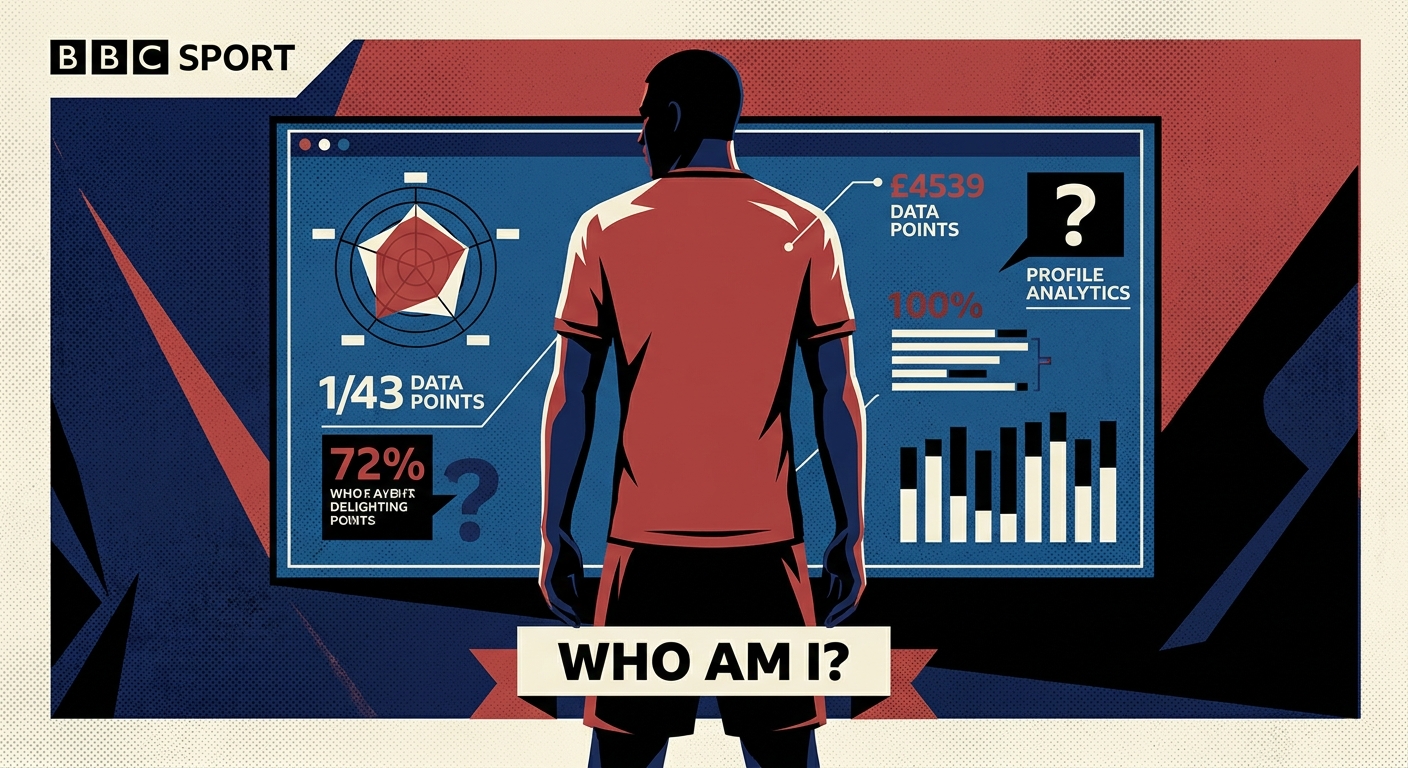
The daily ritual is set. Across the country, football fans are booting up the BBC Sport app to tackle the 20th edition of the highly addictive Who am I? Guess Premier League star quiz. The premise is brilliantly simple: decipher the identity of a mystery footballer using a sequential clue-unlock loop, aiming for the lowest possible score. But while fans view it as a morning test of trivia, we at Matchwise see something entirely different—a perfect distillation of modern data-driven recruitment.
The Anatomy of a Blind Profile
Curated by Joe Rindl, the BBC format strips away the highlight reels and brand recognition, feeding users a drip-feed of positional markers, career trajectories, and raw output. In the world of elite sports analytics, this isn't a game; it's the daily grind. We call it "blind profiling."
When top-tier data departments hunt for reinforcements, they frequently remove player names from their initial filters to avoid inherent scouting biases. They look at the shape of the data before they ever look at the man. If a recruitment director asks for a midfielder producing 8.5 progressive passes per 90, 3.2 tackles, and an elite expected threat (xT) rating, the analyst doesn’t need a name. They know the data footprint matches an elite pivot—the exact sort of statistical profile that just convinced Mikel Arteta's Arsenal to authorize a massive £75m transfer for Newcastle’s Bruno Guimarães this week.
In both the quiz and the scouting room, you are trying to solve a bounded optimization problem. You want the right answer in the fewest iterations possible. Every clue, or every metric, either confirms a hypothesis or forces a swift recalculation.
Data as the Ultimate Clue
The beauty of the Who am I? structure is how rapidly it collapses the candidate pool. A single data point acts as a ruthless filter. You can see this precise logic dictating the frantic pace of the current August 2026 transfer window.
Take Tottenham Hotspur’s current attacking dilemma. With Dominic Solanke nursing an ankle issue that kept him out of a behind-closed-doors friendly against Getafe, Spurs' hierarchy are reportedly weighing up a monumental move for Galatasaray's Victor Osimhen. If you were playing a scouting version of the BBC quiz, the clues for Osimhen—a 27-year-old high-volume striker with extreme box-presence metrics, a history in Serie A and the Super Lig, and €288,000-a-week wage demands—instantly narrow the global field to a pool of one.
Similarly, when Aston Villa look to replace the underlying output of Morgan Rogers following his club-record departure, they won't look for a player with a similar swagger or media profile. They will search their databases for a statistical clone: a ball-carrier who matches his exact progressive carrying distance and final-third entry rate. Even smart, under-the-radar deals—like Crystal Palace snapping up Takehiro Tomiyasu on a free transfer this week—are born from this exact methodology. Palace knew the exact defensive duel success rate they needed, and the Japanese international fit the profile perfectly.
Rewiring How We Watch the Game
Quizzes like Who am I? No. 20 matter deeply because they force casual fans to decouple the superstar from the reality of their on-pitch footprint. It challenges you to recognize the working mechanics of a squad rather than just the names printed on the back of the shirts. It is essentially a low-volume pattern-recognition tool that echoes how analysts track squad turnover and rotation depth across a sprawling 20-club league.
As the transfer window enters its final weeks ahead of the September 1 deadline, clubs will be relying on these exact filtering mechanisms to make season-defining, multi-million-pound decisions. The margin for error is non-existent. Overpay for a player who doesn't fit your tactical clues, and you jeopardize the entire campaign.
So, when you tackle today's mystery player, don't just rely on your memory of Panini stickers or ultimate team ratings. Think like a sporting director. Look at the shape of the career, the function of the positions, and the cold, hard facts of the clues. In modern football, the data always gives the game away.